What Is Correlation (and Why Would You Care)?

Here at Finley Wealth Management, we try to keep the financial jargon to a minimum. But even where we may succeed, you’re likely to encounter references elsewhere that can turn valuable information into mumbo-jumbo yet to be translated.
Consider us your interpreter. Today, we’ll explore correlation, and why it matters to investing.


A Quick Take: Correlation Helps People Invest More Efficiently

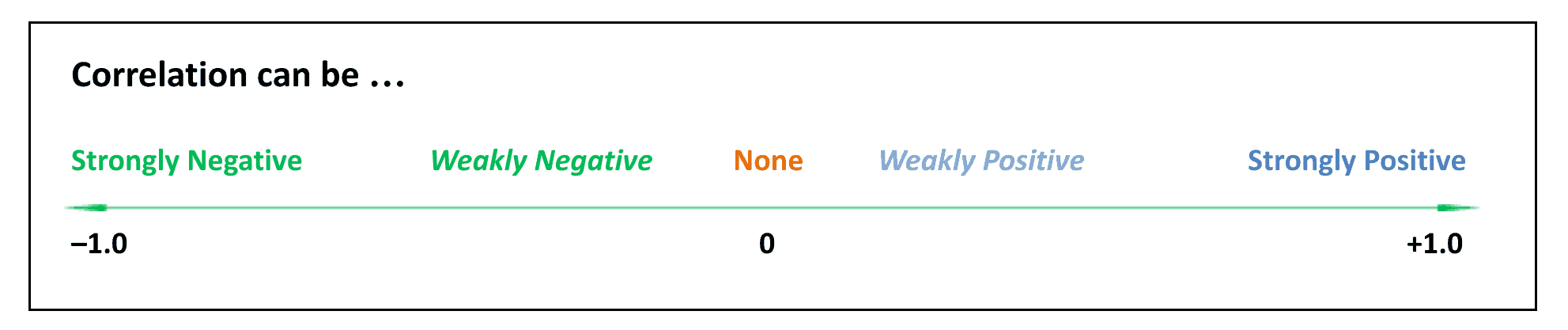
Expressed as a number between –1.0 and +1.0, correlation quantifies whether, and by how much two holdings have behaved differently or alike in various markets. If we can identify holdings with weak or no expected correlation among one another, we can combine these diverse “pieces” (individual investments) into a greater “whole” (an investment portfolio), to help investors better weather the market’s many moods.


Correlation, Defined

As suggested above, correlation is more than just a quality; it’s also a quantity – a measurement – offering two important insights along a spectrum of possibilities between –1.0 and +1.0:

  1. Correlation can be positive or negative, which tells us whether two correlated subjects are behaving similarly to or opposite of one another.
  2. Correlation can be strong or weak (or high/low), which tells us how powerful the similar or opposite behavior has been.

Correlation vs. Causation: Why the Difference Matters

Now, before we get too cozy with our correlation coefficients, it’s worth pausing for an important reality check: correlation and causation are not the same thing. This distinction is at the heart of making smart investment decisions (and, frankly, not getting hoodwinked elsewhere in life, too).

Just because two things seem to move together doesn’t mean one is making the other happen. Take height and basketball: most professional players are tall, but joining your neighborhood basketball league isn’t going to add inches to your frame. Tall folks are simply more likely to excel—and therefore stick—with the sport. The two (height and basketball participation) might be correlated, but height certainly isn’t caused by time spent shooting hoops.

This is a classic pitfall: confusing a statistical relationship (correlation) for a direct cause-and-effect (causation). The differences matter, especially when building portfolios or evaluating financial advice. If we leap to conclusions about causation where only correlation exists, we risk making decisions based on coincidence, not evidence—a recipe for disappointment.

When analyzing investments (or any data), always ask: is there a genuine connection, or are they just traveling together by chance or thanks to a hidden link beneath the surface? Good research (and a healthy dose of skepticism) helps keep your strategy on firm ground.

Unsystematic Risk: The Role of Correlation

Now, what about unsystematic risk—and how does correlation tie in? Unsystematic risk refers to those unpredictable ups and downs that affect just a single company, sector, or asset class, rather than the entire market. Think of it as the unique plot twists in the daily soap opera of a particular stock (say, if your favorite tech company’s CEO suddenly decides to become a professional surfer). These risks can often be managed, or even diminished, by thoughtfully combining investments that don’t move in lockstep with each other.

Here’s where correlation comes into play: When you add assets to your portfolio that have little to no correlation with each other, you’re effectively spreading out your risk. If one investment hits a rough patch, others may remain steady or even thrive. This diversifying effect helps minimize the chance that any single event will throw your entire portfolio off course—leaving you better positioned to pursue those long-term goals, even when the market narrative changes unexpectedly.

Seeing Correlation in Action: Scatterplots to the Rescue

It can be tricky to wrap your head around numbers—so let’s give them a little visual flair. Enter the scatterplot: a classic tool for spotting correlation in the wild.

Imagine a scatterplot as a chart where each dot represents a pair of data points (say, the value of two investments over time). The horizontal (x) axis tracks one variable; the vertical (y) axis tracks another. You may have seen scatterplots used in everything from investment returns and risk to SAT scores versus college GPA—anywhere two measures might move together (or not).

Why scatterplots? Because they let you see the relationship, not just calculate it. If the dots tend to cluster along an upward-sloping line, the variables are positively correlated—they rise (and possibly fall) together. If the trend slants downward, that’s negative correlation; as one rises, the other falls. And if the dots are scattered with no obvious pattern or direction, that suggests little to no correlation at all.

Sometimes relationships aren’t just straight lines. If there’s a curve, or if the pattern changes partway through, scatterplots can help you spot that nuance at a glance—something a single correlation number might miss.

Scatterplots can also feature density shading—think of it as a gentle highlight over the region where the most dots appear. When the dense area forms a tilted oval, that mirrors the direction of any trend. A more circular or diffuse shaded area hints at weaker or nonexistent correlation.

In short, scatterplots turn abstract relationships into an easy-to-grasp image, making it much simpler to appreciate what correlation looks like in practice.

The Role of P-Values in Assessing Correlation

If you’ve ever peeked behind the curtain of investment research, you may have bumped into a curious creature called the “p-value.” So, what exactly is it, and why might you care?

P-values are statistical tools that help us figure out whether the correlation we see between two investments—or any sets of data, for that matter—is likely to be genuine, or just the luck of the draw. Think of a p-value as your reality check: It shows us how probable it is that an observed connection between two holdings happened simply by chance.

Low p-value: This suggests there’s strong evidence that the observed correlation isn’t just a fluke, but is likely meaningful.
High p-value: On the flip side, a high p-value says we don’t have enough proof to confidently say the correlation is real. In other words, any apparent relationship might be random noise.
For investors and analysts, using p-values helps ensure we’re not being fooled into seeing relationships where none exist—keeping our portfolios sturdier and our decision-making a bit more science-based.


Correlation, Applied

If you’ve been around the investment block, you’ve probably heard about the benefits of diversification, or owning many, as well as many different kinds of holdings. A well-diversified portfolio helps you invest more efficiently and effectively over time. Diversification also offers a smoother ride, which helps you better stay on course toward your personal financial goals.
But in a world of nearly infinite possibilities, how do we:

  • Compare existing funds – If one fund is expected to perform a certain way according to its averages, and another fund is supposed to perform differently according to its own averages, how do you know if they’re really performing differently as expected?
  • Compare new factors – What about when a researcher claims they’ve found a new factor or source of expected returns? As this University of Chicago paper explains, “factors are being discovered almost as quickly as they can be packaged and sold to the waiting public.” How do we determine which are actually worth considering out of the hundreds proposed?
  • Compare one portfolio to another – Even perfectly good factors don’t always fit well together. You want factors that are not only strong on their own, but that is expected to create the strongest possible total portfolio once they’re combined.

Correlation is the answer to these and other portfolio analysis challenges. By quantifying and comparing the behaviors and relationships found among various funds, factors, and portfolios, we can better determine which combinations are expected to produce optimal outcomes over time.

Correlation Across Asset Classes

So, where does correlation show up in the real world of investing? It’s especially meaningful when you’re deciding how to combine a variety of asset classes—think stocks, bonds, commodities, and real estate—into your portfolio mix.

Each asset class has its own personality and doesn’t always dance to the same tune as its counterparts. For example, stocks and bonds typically don’t move in lockstep; when one zigzags, the other might stay steady or even zag the other way. Commodities, like gold or oil, may move independently from both stocks and bonds—sometimes even acting as a stabilizer during broader market upheavals. Real estate, meanwhile, can chart its own course based on different economic drivers, like local demand and interest rates.

By thoughtfully combining these non-correlated (or even oppositely correlated) asset classes, you can help reduce the odds that a rough patch in one area will bring down your whole portfolio. Instead, the various investments can help counterbalance each other, offering the resilience needed to ride out the ever-changing market cycles.

How Do Professionals Use Historical Correlation in Practice?

Financial professionals regularly turn to historical correlations as a detective might consult clues at a crime scene. By analyzing how certain investments have moved in relation to one another—or in response to changing economic factors like interest rates or commodity prices—they can make more informed predictions about what might happen next.

For example, imagine you’re wondering how a specific stock could fare if oil prices suddenly spike. By looking at records of past price movements, you can identify whether the stock has typically risen, fallen, or stayed relatively neutral during similar moments in history. This insight lets traders, portfolio managers, and researchers anticipate how different holdings might react to future economic shocks or policy moves.

In this way, historical correlation acts as a helpful compass. It doesn’t guarantee results—markets do like their surprises—but it can guide decisions and offer a bit of steadiness as you navigate the wilds of global investing.

Correlation, Calculated

Fortunately, as an investor, you don’t necessarily need to know how to precisely calculate correlations. But it’s useful to know what correlation measurements mean when you see them.

How Correlation Is Calculated: A Step-by-Step Example

Let’s say you’re interested in crunching the numbers yourself—just for fun, or perhaps to impress your next cocktail party audience (yes, we’re that kind of crowd). Here’s a straightforward look at how you might calculate the correlation between two sample sets of investment returns.

The Data
Imagine you have two investments, Portfolio X and Portfolio Y, and you’ve tracked their annual returns over seven years. Your numbers look like this:

X: 41, 19, 23, 40, 55, 57, 33
Y: 94, 60, 74, 71, 82, 76, 61
The Steps
Tally the Totals:Add up all the values for X (let’s call this SUM(X)).
Do the same for Y (SUM(Y)).
Multiply each X and Y pair, then add up those products (SUM(XY)).
Square and Sum:Square each X value, then sum those results (SUM(X²)).
Repeat for Y (SUM(Y²)).
Plug Into the Formula:
The data alone doesn’t do much for us, so we use the widely-accepted correlation formula:

[ r = \frac{n \times SUM(XY) – SUM(X) \times SUM(Y)}{\sqrt{[n \times SUM(X^2) – (SUM(X))^2] \times [n \times SUM(Y^2) – (SUM(Y))^2]}} ]

Where:

r = correlation coefficient
n = number of data points (in this case, 7)
The Math (but Keep Your Calculator Handy)
So, for our made-up portfolios:

SUM(X) = 268
SUM(Y) = 518
SUM(XY) = 20,391
SUM(X²) = 11,534
SUM(Y²) = 39,174
n = 7
Plug these numbers into the formula, and you get:

[ r = \frac{(7 \times 20,391) – (268 \times 518)}{\sqrt{(7 \times 11,534 – 268^2) \times (7 \times 39,174 – 518^2)}} ]

Crunch all of that, and you find:

The numerator = 3,913
The denominator = 7,248.4
So, the correlation coefficient, r, is about 0.54.

What Does That Mean?

A correlation of 0.54 signals a moderately positive relationship—when one investment goes up, the other tends to go up as well (though not perfectly in lockstep). This sort of calculation helps investors see how much—or how little—their holdings really march to the same drummer.

The Pearson Correlation Formula – Demystified

You may be wondering, what’s happening behind the scenes when analysts calculate correlation? Enter the Pearson product-moment correlation coefficient—a mathematical mouthful, but a staple in financial research.

The basic formula looks daunting at first blush, but here’s the simple version:

Correlation (r) =
Divide the average “shared movement” between two sets of returns (think Fund X and Fund Y) by the product of their individual volatilities. Or, if you prefer algebra:

n × Σ(XY) – ΣX × ΣY
r = √[ (n × Σ(X²) – (ΣX)²) × (n × Σ(Y²) – (ΣY)²) ]

Where:

r = correlation coefficient (the number between –1.0 and +1.0)
n = total number of paired data points (such as monthly returns)
X and Y = each set of data (like the monthly returns for each fund)
While you don’t need to crunch these numbers yourself (that’s what spreadsheets and financial software are for!), understanding that a correlation coefficient is simply comparing how two investments move together versus independently is plenty for most practical investing decisions.

Now, let’s put these numbers in context…

How Do You Manually Calculate a Correlation Coefficient?

If you’re the curious, do-it-yourself type, you might wonder how that neat little correlation number is actually produced. While financial software and spreadsheets will happily crunch it for you, here’s a peek behind the curtain at the steps involved in calculating the most common version: the Pearson correlation coefficient.

Let’s break it down:

  1. Assemble Your Data: Start with two sets of numbers—think Fund X’s annual returns and Fund Y’s over the same time period.
  2. Calculate the Averages: Find the mean (average) for each set. Jot those numbers down; you’ll need them next.
  3. Measure the Differences: Subtract each set’s mean from the corresponding values in its data series. This gives you the “distance” each value is from the average.
  4. Multiply the Differences: For each pair, multiply the difference from the first set by the difference from the second set.
  5. Sum It All Up: Add together all those products you just found.
  6. Standardize It: Now, calculate the square root of the multiplied sums of squared differences for each set. In plain English: square each difference you found in Step 3, add them up for each set, then multiply the two totals together, and finally take the square root of that result.
  7. Divide and Conquer: Divide the total you got in Step 5 by the result from Step 6.

The finish line: that shiny number (between –1.0 and +1.0) is your correlation coefficient—it tells you just how closely your two investments have tangoed through market history.

  • Strong (high), positive correlation tells us that two investments seem to be playing a highly similar role; when that’s the case, you may not need to hold both of them.
  • Strong (high), negative correlation offers the most diversification, but it’s hard to find. Prone as they are to herd mentality, most holdings follow general trends at least a little.
  • Weak (low) or no (zero) correlation is thus the preferred relationship we typically seek between and among the funds we use to build a diversified portfolio.
  • Strong (high), positive correlation tells us that two investments seem to be playing a highly similar role; when that’s the case, you may not need to hold both of them.
  • Strong (high), negative correlation offers the most diversification, but it’s hard to find. Prone as they are to herd mentality, most holdings follow general trends at least a little.
  • Weak (low) or no (zero) correlation is thus the preferred relationship we typically seek between and among the funds we use to build a diversified portfolio.

Is More Correlation Always Better?

Not necessarily. While it might be tempting to think that all your investments should march in perfect step with one another, a high correlation among your holdings often means you’re putting too many eggs in one basket—limiting the benefits that diversification can provide.

Generally, investors seek lower correlations between their portfolio holdings, as this helps reduce the risk that all their investments will respond similarly to the same market forces. When your assets move independently (or at least not in lockstep), a downturn in one area is less likely to drag down your entire portfolio.

That said, there are some circumstances where a higher correlation might be appropriate—such as if you’re intentionally seeking concentrated exposure to a particular sector, theme, or trend. In those cases, you accept increased risk in hopes of greater potential reward, knowing that the fortunes of your investments are more closely tied together.

Ultimately, while a little correlation is inevitable, the goal for most investors is to craft a mix of assets with satisfying doses of independence, providing the portfolio with resilience across a variety of markets and economic cycles.

Beware of Small Samples and Outliers

As with many tools in investing, correlation measurements have their caveats—particularly when dealing with small sample sizes or outliers.

When the data pool is limited, correlation readings can be misleading. A handful of results may exaggerate the strength (or weakness) of the connection between two holdings, simply due to chance rather than actual, persistent relationships. In other words, the numbers might claim a story that isn’t really there—making it risky to act on these findings without broader context.

Similarly, a single extreme data point—a so-called outlier—can throw off your correlation analysis. Outliers have a habit of distorting otherwise sensible results, much like a rogue wave can skew the “average” calmness of the sea. So while correlation can provide helpful insights, it’s always wise to look at plenty of data and keep an eye out for those oddball results that can pull your analysis in the wrong direction.

Calculating Correlation with Spreadsheets

Instead of rolling up your sleeves for some heavy-duty math, you can let your spreadsheet do the number-crunching for you. Most spreadsheet programs—like Microsoft Excel or Google Sheets—offer built-in functions to quickly measure correlation between two sets of numbers.

Here’s how it works:

  • Simply enter your data (perhaps two columns: one for each investment’s returns).
  • Use a function (such as CORREL in Excel or Google Sheets) to calculate the correlation coefficient in a snap.
  • The result will show you where that relationship lands, from –1.0 (perfectly negative) to +1.0 (perfectly positive).

This automated approach saves time and helps ensure accuracy—letting you focus on big-picture portfolio decisions.

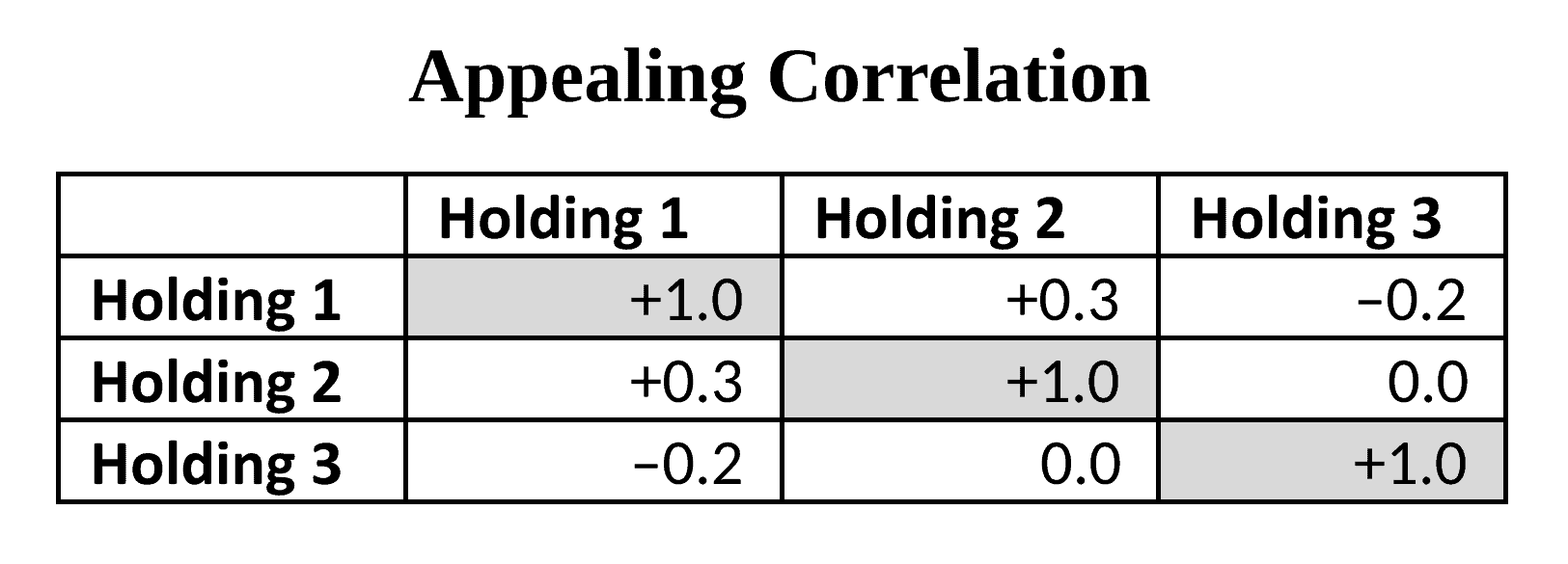
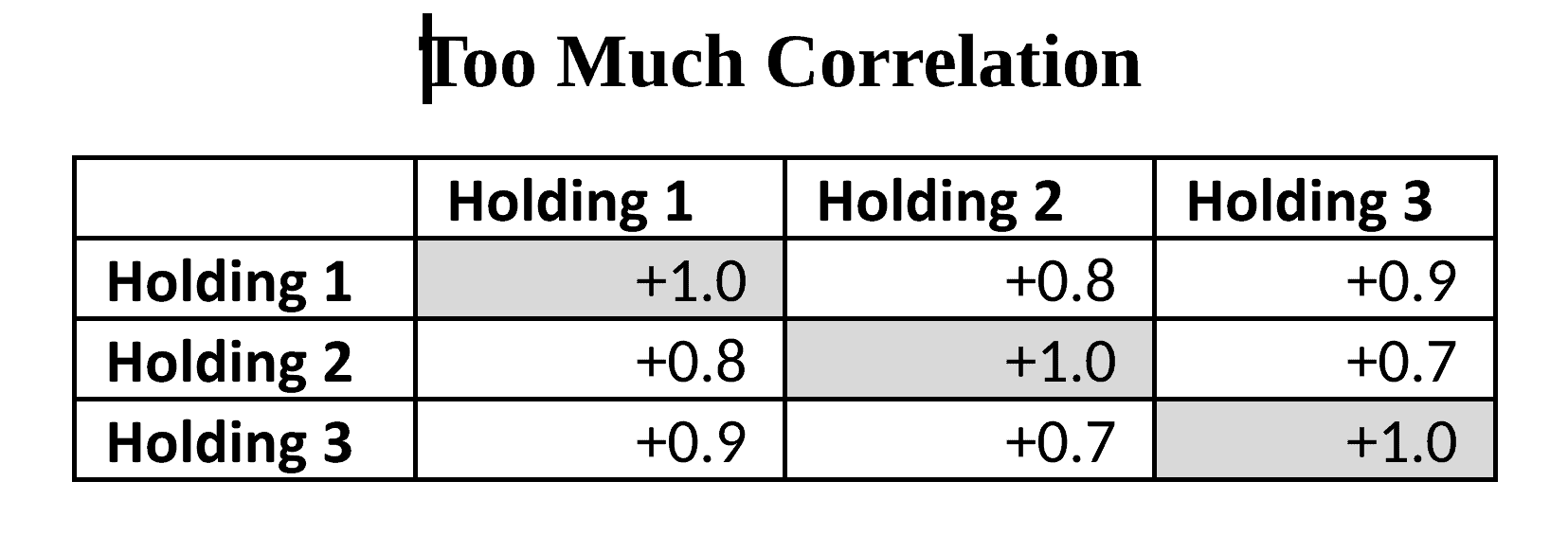
Here’s a simplified example of an appealing correlation among three holdings. Each holding exhibits a satisfying level of weak or no correlation with the other two. (A holding will always have a perfect positive correlation with itself, thus the +1.0 measurements.) What if your correlations look more like the trio below? Because all correlations here are strongly positive, you might reconsider whether these holdings are sufficiently diversified to make the most of varied market conditions and sources of expected returns. Correlation, Clarified

It’s worth adding a couple more clarifying points before we wrap.

Comparing Investments – First, the correlation between two holdings is not calculated by directly comparing the returns of each holding. Instead, we compare how each holding’s returns move up and down relative to its own average returns. In “Reducing the Risk of Black Swans,” co-authors Larry Swedroe and Kevin Grogan illustrate how this works:
“A positive correlation exists between two assets when one asset produces above-average returns (relative to its average) and the other asset tends to also produce above-average returns (relative to its average). The stronger the tendency, the closer the correlation will be to +1.”
In other words, two investments may seem quite different at a glance. But if you compare them to their own usual performance, and they both tend to sink or soar in reaction to the same market conditions, they are unlikely to offer strong diversification benefits if you pair them together.

Going the Distance – Also, correlation is not a “set it and forget it” number. For example, two funds may usually exhibit a weak correlation, but this can shift if a bear or bull market roars in and wreaks havoc on business as usual. In short, the solid analysis calls for studying correlation data across multiple markets and over time, to better understand what to expect during various market conditions. This is another reason to take care when adding new factors to your portfolio. Even if a new opportunity seems promising, you may want to wait and see how it performs over time and around the globe before you buy into the latest popular find.

Correlation, Misunderstood

So, where do investors sometimes trip up when interpreting correlation data? There are a few common pitfalls worth keeping on your radar:

Small Sample Size Snafus: Drawing conclusions from a limited set of data is like trying to forecast the climate based on one week’s weather forecast in London—hardly representative! Small samples can exaggerate or mask relationships, making correlations appear stronger or weaker than they truly are over the long haul.
Outlier Influence: Ever had a rogue element skew the group project? Outliers—those rare, extreme data points—can throw off correlation measurements, giving you a misleading sense of how tightly two investments actually move together.
Linear Blinders: Correlation coefficients are designed to spot straight-line relationships—where one thing moves predictably up or down with another. But markets are anything but straight-laced. Complex, curvy relationships between assets often fly under the radar, leading us to miss meaningful connections (or lack thereof) just because they aren’t a simple up-or-down affair.
Confusing Connection for Causation: Perhaps the classic misstep: assuming that just because two funds have moved together in the past, one must be causing the other. Cue the age-old warning: correlation does not imply causation.
By staying alert to these common misinterpretations, you’ll keep your diversification strategy rooted in reality—no magic tricks, cherry-picked stats, or wishful thinking required.

Correlation, Concluded  
Heeding correlation data is a lot like having a full line-up on your favorite sports team. If each player on the roster adds a distinct, useful, and well-played talent to the mix, odds are, your team will go far. Similarly, your investment portfolio is best built from a global “team” of distinct factors, or sources of returns. A winning approach combines quality components that exhibit weak or no correlation among or between them across varied, long-term market conditions.

Let us know if we can help you use correlation to enhance your own investment experience.

About the Author Douglas Finley, MS, CPWA, CFP, AEP, CDFA

Douglas Finley, MS, CFP, AEP, CDFA founded Finley Wealth Advisors in February of 2006, as a Fiduciary Fee-Only Registered Investment Advisor, with the goal of creating a firm that eliminated the conflicts of interest inherent in the financial planner – advisor/client relationship. The firm specializes in wealth management for the middle-class millionaire.


follow me on:
>