

Indices are samplings of the market and may differ substantially among index providers based on differences in construction methodology. Nowhere is that more evident than in US small cap stocks.
Defining Market Capitalization and Small Cap Ranges
Market capitalization, or “market cap” for short, measures a company’s total value in the market. It’s simply the share price multiplied by the total number of shares in circulation—a quick calculation, but one that tells you where a company sits in the market’s pecking order.
For small cap stocks, the usual cutoff points land between $300 million and $2 billion in market capitalization. This range brackets the “small” end of the public company universe, sandwiched between micro caps below and mid caps above.
Understanding Small Cap Stocks
So, what exactly falls under the “small cap” umbrella? Small cap stocks typically belong to companies valued between about $300 million and $2 billion. In market-speak, we’re talking about the little engines that could: businesses that haven’t yet reached household-name status, but still pack plenty of punch.
These stocks can offer more dramatic ups and downs than their large cap cousins. It’s the nature of the beast—being smaller and often newer makes them more nimble, but sometimes a bit wobbly. While small caps tend to face higher risks and occasionally thinner trading volume, they’ve also historically delivered outsized returns for those willing to ride out the bumps.
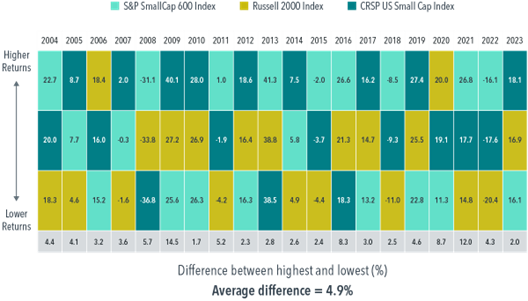
The spread in returns between the best and worst performer among three major indices—S&P SmallCap 600 Index, Russell 2000 Index, and CRSP US Small Cap Index—has averaged 4.9% per year over the past two decades. This gulf in returns has even crested double digits a couple of times.
Why Invest in Small Cap Stocks?
It’s not just the potential for a big payout that makes small cap stocks fascinating. Several core advantages drive their appeal among seasoned investors and market rookies alike:
Room to Grow: Smaller companies tend to have more runway for expansion than established giants. Their growth spurts can translate into outsized returns if they capture new markets or scale quickly.
Under-the-Radar Opportunities: With less attention from Wall Street analysts, these stocks can slip beneath the radar. That makes it easier for diligent investors to uncover bargains—companies whose value the broader market hasn’t priced in yet.
Acquisition Appeal: Many small firms end up on the shopping lists of larger corporations eager to snap up niche expertise or promising new technologies. When buyouts happen, share prices often get a healthy boost.
Portfolio Diversification: Adding small caps to a portfolio can offer a layer of diversification. They often don’t move in lockstep with their large cap counterparts, helping to spread risk, especially during market turns.
Agility: Smaller firms can pivot quickly. Without layers of bureaucracy, they’re often better positioned to adjust to trends, regulatory shifts, or sudden opportunities.
Of course, not every small cap stock will be a diamond in the rough. But for investors willing to stomach the extra volatility, the small cap sector can offer an intriguing combination of potential growth and strategic opportunity.
How Small Cap Stocks Differ from Penny Stocks
It’s easy to lump all “smaller” companies together, but small cap stocks and penny stocks live in very different neighborhoods. Small caps, such as those found in the S&P SmallCap 600 or Russell 2000, represent companies with a lower market value compared to giants like Apple or Microsoft, but these firms are still established, subject to financial reporting standards, and traded on major exchanges.
Penny stocks, on the other hand, usually trade for less than $5 per share—sometimes mere cents—and often belong to far tinier companies. These thinly traded stocks commonly appear on over-the-counter markets and tend to carry very little in the way of regulatory oversight or reliable public information.
The key distinction? While small cap stocks certainly come with more risk and volatility than blue chips, they are a far cry from penny stocks, which are typically far riskier, less transparent, and more prone to speculative swings. For investors, that can be the difference between taking the scenic back road and jumping off a cliff.
The chart shows randomness in the winning index year to year. All three indices have taken their turn as the top and bottom performer. None stands out as a “better” way to capture small caps. Funds tracking any of these indices may leave returns on the table due to indexing constraints, such as arbitrary rebalancing frequency and lack of a daily process.
Exploring Your Options for Investing in Small Cap Stocks
Given the differing results among major small cap indices, investors face a multitude of approaches when seeking exposure to this corner of the market. All avenues come with their own sets of trade-offs, just as the index methodologies themselves do.
Here are a few primary routes to consider:
1. Building Your Own Small Cap Collection
You can roll up your sleeves and select individual small cap companies to hold in your portfolio. This hands-on method offers maximum customization—but, much like fine-tuning an index, it demands research, ongoing monitoring, and a stomach for volatility. Controlling your own destiny comes with a healthy dose of homework.
2. Small Cap Mutual Funds
For those after diversification in one fell swoop, mutual funds focused on small caps pool investor money and spread it across a basket of companies. Professional managers steer the ship here, deciding when and where to invest within the small cap universe. This approach typically offers a smoother ride and less company-specific risk, though management fees tend to be higher than passively managed options.
3. Small Cap ETFs
Exchange-traded funds (ETFs) tracking small cap indices—such as the Russell 2000 or the S&P SmallCap 600—offer a lower-cost, easily tradable way to mirror a slice of the small cap market. These behave much like stocks on an exchange, and the expense ratios are generally lighter. However, as discussed earlier, the flavor of “small cap” you get depends on which index the ETF follows.
4. Automated and Digital Platforms
Some investors now lean on automated platforms (robo-advisors) that assemble portfolios incorporating small cap exposure according to your risk appetite and investment timeline. These aim to simplify decision-making and provide regular rebalancing—ideal for those who prefer a more hands-off approach.
Each method has its allure, but no shortcut eliminates the underlying uncertainty baked into small cap investing—or the quirks of the chosen index. Defining your strategy and comfort with complexity should guide which path you take.
Navigating Volatility: A Pragmatic Approach to Small Cap Investing
Given the historical swings in small cap performance and the unpredictable nature of index “winners,” approaching small caps calls for a certain degree of humility and a practical playbook. Small cap stocks, by their very nature, tend to keep investors on their toes—higher potential for growth sits side by side with pronounced risk.
How can investors turn these challenges into opportunities? Here are several guiding principles to keep you grounded:
Diversify Broadly: No single index consistently outperforms, and the same applies to individual companies. Casting a wide net across different small cap names (ideally through broad-based ETFs or mutual funds tracking indices like the S&P SmallCap 600, Russell 2000, or CRSP US Small Cap Index) helps smooth out the bumps. Remember, the specific recipe doesn’t matter as much as true exposure to the asset class.
Plan for Volatility: Accept that sharp swings are par for the course. If news headlines and market drops are likely to shake your confidence, sizing your allocation conservatively or pairing small caps with more stable holdings could be wise.
Check Your Timeline: Small cap investing works best when paired with a long runway. Time is your friend when riding out rough patches and giving growth stories space to unfold.
Be Wary of Thin Trading: Smaller companies can have less liquid stocks, with wider bid/ask spreads and occasional trading hiccups. Before diving in deep—especially with individual names—assess whether you can efficiently get in and out without excessive costs.
Dig Deeper, But Stay Humble: While less analyst coverage means more room for diligent research, it also means less information is available. Avoid falling in love with any one stock based on a hunch. Some companies will thrive, others will stumble—the hard part is knowing which ahead of time.
Accept Uncertainty: No crystal ball exists. Even well-constructed indices rotate through periods of out- and underperformance, with sector trends, economic cycles, and unpredictable events all playing a role. Staying diversified, focusing on process over predictions, and reviewing your portfolio regularly can help you adapt.
Ultimately, small cap investing is not a game of picking the next big star but rather one of maximizing your exposure to the broad opportunity set while acknowledging—and preparing for—the bumps along the way.
The bottom line: Approach small caps with discipline, wide diversification, a long-term mindset, and a healthy respect for uncertainty. While their journey may not always be smooth, there’s value in embracing both their unpredictability and their potential.
Why Are Small Cap Stocks Seen as Riskier?
The perception of greater risk with small cap stocks comes down to a few key factors. These companies tend to be younger, still carving out their niche, and lacking the financial cushion or brand recognition that giants like Apple or Procter & Gamble enjoy. Their limited resources can make it tougher to weather economic storms or unexpected setbacks.
On top of that, small caps don’t trade as actively as their larger counterparts, so prices can swing more wildly with each trade. This lower liquidity means investors may sometimes have a harder time buying or selling shares without affecting the stock price. All combined, these characteristics make small cap stocks more volatile and, in many eyes, riskier compared to large, established firms.
Evaluating Risk and Doing Your Homework
Given this unpredictability, investors eyeing small cap stocks should approach with both curiosity and caution. No matter how appealing next year’s forecasts may sound, a healthy dose of due diligence is essential. Before committing capital, consider the variability of returns across different indices and recognize how your own risk tolerance aligns with the inherent swings in small cap performance.
A few guiding principles can help:
- Assess your investment goals and the amount of volatility you’re comfortable stomaching—small caps are not for the faint of heart.
- Investigate how each index is constructed, as differences here can lead to sizeable performance divergences.
- Take the time to understand fund methodologies, rebalance routines, and the potential impact these mechanics have on long-term returns.
By approaching small caps with your eyes wide open and expectations grounded in research, you’ll be better equipped to weather the market’s surprises—both pleasant and otherwise.
The Influence of Economic Shifts and Sector Swings
Economic conditions and sector performance can shape small cap stock returns in unpredictable ways. In some years, you may see technology or healthcare companies leading the charge, particularly when innovation or economic expansion is in the air. At other times, entirely different sectors—think industrials or consumer discretionary—might steal the spotlight depending on shifting tides in the economy.
What’s consistent is the volatility: small cap stocks, by nature, experience sharper swings than their large cap cousins. This volatility means that while sector leadership sometimes emerges, it’s unusually hard to forecast which slice of the small cap universe will come out ahead next year. Active managers, who can adjust holdings based on sector outlook or changing economic winds, may find opportunities, but they also wrestle with the same uncertainties as index providers—plus an extra dose of unpredictability.
In short, the interplay between sector dynamics and the broader economy is ever-shifting, making the small cap landscape a test track for the unexpected—no matter your chosen index or strategy.
Why Diversification Matters with Small Caps
It’s tempting to put all your eggs in one high-flying basket, especially after seeing how unpredictable small cap returns can be. But diversification is your best defense against that unpredictability. Because small cap stocks often zig when their larger counterparts zag—or sometimes when everything zags—spreading your investments across a broad mix can help smooth out the ride.
Including small caps as part of a diversified portfolio not only helps manage risk, it can also capture unique sources of return that aren’t always tethered to the fates of bigger companies. In short: diversification isn’t just about lowering risk, it’s about balancing exposure so that no single pocket of volatility has the final say on your outcome.
Spotlight on Small Cap Standouts
To put some names to the story, let’s take a peek under the hood of a well-known small cap index fund. The largest ETF tracking the Russell 2000, for instance, has historically held an eclectic mix of firms operating in everything from high-tech data centers to trendy cosmetics aisles. Here are several recent examples that have stood out among the top weights:
Super Micro Computer, Inc. (SMCI): A powerhouse in server and data center hardware, supplying the backbone for cloud providers, financial institutions, and government agencies alike.
e.l.f. Beauty, Inc. (ELF): The Oakland-based beauty brand making waves with its accessible, cruelty-free makeup, living proof that high growth can come from the drugstore aisle.
MicroStrategy Incorporated (MSTR): Once known for enterprise software, this company has made headlines for betting the balance sheet on cryptocurrencies—specifically, Bitcoin.
Comfort Systems USA, Inc. (FIX): Specialists in keeping American commercial buildings comfortable, their reach spans HVAC, electrical, and plumbing services nationwide.
Onto Innovation, Inc. (ONTO): A key supplier to the semiconductor industry, born from the fusion of two seasoned firms, providing the tools that help turn silicon wafers into tomorrow’s microchips.
These companies are a reminder of just how much variety—and opportunity—can be packed into the small cap space. Rather than household names, they’re often at the intersection of innovation and everyday utility, each taking a very different approach to growth.
Exhibit 1 – Three’s Company Annual (index returns, 2004– 2023)
Past performance is not a guarantee of future results.
Indices are not available for direct investment; therefore, their performance does not reflect the expenses associated with the management of an actual portfolio.
How Small, Mid, and Large Cap Stocks Stack Up
When it comes to stocks, size does matter—a lot. The essential differences between small, mid, and large cap stocks boil down to how much risk and growth potential you’re after, and just how big a splash each type of company makes in the market pool.
Small Cap Stocks: Think of these as the nimble speedboats of the investing world. With market capitalizations typically ranging from about $300 million up to $2 billion (though definitions can vary), these companies have room to grow—and occasionally, to capsize. Small caps can deliver impressive growth spurts, but they often ride choppier waters, with greater swings in price and risk.
Mid Cap Stocks: Sitting squarely between the extremes, mid caps chart a course that balances risk and reward. These companies, generally valued from $2 billion to $10 billion, aren’t as established as the titans, but they’re not unproven upstarts either. For investors seeking a middle ground—moderate growth, not-too-wild volatility—mid caps fit the bill.
Large Cap Stocks: These are the ocean liners, boasting market caps above $10 billion (sometimes climbing all the way to the trillion-dollar club—think Apple or Microsoft). Large caps are typically industry stalwarts with a steady hand on the wheel. They may not promise rocket-fueled returns, but for those who prize stability and lower risk, large caps offer a smoother ride.
So, whether you’re after growth potential, stability, or something in between, the cap size you choose can help steer your portfolio in the right direction.
Exploring Your Small Cap Stock Investment Options
Venturing into small cap stocks can be as straightforward or as nuanced as you prefer. To help you parse through the possibilities, let’s break down the pros and cons of four popular approaches: picking stocks yourself, opting for mutual funds, choosing ETFs, or letting a robo advisor crunch the numbers.
Going Solo: Individual Stock Picking
Imagine strolling into a farmer’s market and selecting each apple yourself. Buying individual small cap stocks offers similar autonomy. You control exactly which companies make the cut, tailoring your portfolio to your convictions.
Benefits:
Full control over selections and timing
Potential for outsized gains if you pick a winner
Ability to align investments with personal interests or sector bets
Drawbacks:
Requires substantial research, time, and skill
Higher risk due to lack of diversification
Market swings can sting more without a buffer
Small Cap Mutual Funds: Teamwork Makes the Dream Work
Prefer to let someone else handle the heavy lifting? That’s where mutual funds enter the picture. A team of seasoned managers curates a basket of small caps for you, providing instant diversification.
Benefits:
Professionally managed, saving you both time and homework
Access to a diversified mix, reducing company-specific risk
Reinvestment and rebalancing handled automatically
Drawbacks:
Management fees can be higher than other pooled vehicles
Less control over individual holdings
Performance may lag the overall market after fees
Small Cap ETFs: Diversification Meets Flexibility
Exchange-traded funds (ETFs) offer a middle ground. Like mutual funds, they give you a slice of a broad portfolio—think Russell 2000 or S&P SmallCap 600—except you can trade them throughout the day, just like a stock.
Benefits:
Typically lower costs compared to mutual funds
Easy to buy and sell during market hours
Broad exposure to many companies in one purchase
Drawbacks:
Still subject to market volatility
Less hands-on management than active mutual funds
Investors may be tempted to trade too frequently
Robo Advisors: Set It and (Mostly) Forget It
For those who’d rather let technology handle the details, robo advisors provide digitally-managed portfolios—including small cap allocations—tailored to your goals and risk tolerance.
Benefits:
Automated diversification and rebalancing
Generally low minimums and transparent fees
Hands-off, hassle-free investing
Drawbacks:
Limited ability to customize individual stock or fund choices
Algorithm-driven, so lacks the intuition of human managers
You may not have direct access to every small cap you’re interested in
Choosing between these avenues depends on your appetite for research, comfort with risk, and desire for control. Whether you’re hands-on or hands-off, knowing the trade-offs will help you make smarter decisions as you explore the exciting—but sometimes wild—world of small cap stocks.
Interest Rates and Small Caps: A Delicate Dance
When interest rates reach their peak or begin to fall, small-cap stocks often find themselves in a more favorable position. Lower borrowing costs can make it easier for these smaller companies—think the nimble upstarts rather than the corporate giants—to access capital needed for expansion and innovation. This, in turn, has the potential to boost their growth prospects and draw the attention of investors searching for opportunity.
But it’s not just about access to cheaper loans. Reduced rates may encourage broader economic activity, which often supports sectors where small caps have a larger footprint. As always, while these trends can be promising, they come with the usual caveat: no one owns a crystal ball, and market environments can turn on a dime.
What Could Stand in the Way for Small-Cap Stocks in 2024?
While the past returns may look tempting on the chart, it’s worth peeking around the corner for potential hurdles this year.
Global Tensions: World events—from elections in big economies to sudden geopolitical flare-ups—can cause a bout of market nerves, often felt more keenly by smaller companies with less diversified operations.
Inflation’s Stubborn Streak: If inflation stays sticky, input costs can squeeze profits. On top of that, central banks like the Federal Reserve might keep borrowing costs elevated, making it tougher for smaller businesses to access affordable capital.
Market Sentiment: Uncertainty in broader economic conditions sometimes leads investors to steer clear of small caps, favoring steadier names until the dust settles.
Keeping these risks on your radar is key—because even the most promising index chart can’t predict tomorrow’s headlines.
What Could Boost Small Cap Stocks in 2024?
As we turn our gaze to the horizon of 2024, several green shoots suggest reasons for small-cap investors to feel cautiously optimistic. First up, valuations for small companies remain on the humble side compared to their larger counterparts—a bit like finding designer shoes at an outlet price. For bargain hunters and those searching for potential growth, this discount window could prove tempting.
Interest rates also play a starring role. Should the Federal Reserve decide to hit pause—or even reverse—the recent rate hikes, smaller firms stand to benefit. Lower borrowing costs can be a lifeline, making it easier for nimble businesses to access capital, fund expansion, and potentially spark stock price momentum.
And let’s not forget the macro backdrop. A resilient or improving U.S. economy adds fuel to the small-cap engine. These companies often have more skin in the domestic game, so as Main Street businesses find their footing, small-cap indexes can be well-positioned to ride the wave.
The Distinction: Small Value vs. Small Growth Stocks
So, what’s the real difference between small value stocks and small growth stocks? While both proudly claim their spots among small-cap companies, they take rather different approaches to how they drive returns—and how investors tend to perceive them.
Small value stocks are those under-the-radar companies whose share prices seem low relative to fundamentals like earnings, book value, or even dividend yield. Think of them as the “diamonds in the rough”—often overlooked, frequently trading at a discount, but sometimes poised for a comeback when market sentiment catches up with their true potential.
Small growth stocks, on the other hand, are typically priced for optimism. These are younger companies the market expects to grow quickly, perhaps outpacing their peers and even larger rivals. Investors are willing to pay a premium, betting big on the company’s future expansion—even if the current numbers don’t quite look impressive on paper.
In a nutshell: value stocks may offer hidden strength waiting to be discovered, while growth stocks are all about chasing potential—even if you’re paying top dollar for it.
What’s Next for Small Cap Stocks and ETFs in 2024?
So, where are small cap stocks and their ETF cousins heading in 2024? If Wall Street’s soothsayers are to be believed, the forecast is—brace yourself for the meteorological analogy—partly sunny with a chance of showers.
On the bright side, small caps are wandering out of 2023’s shadow with relatively attractive price tags. Think of them as the outlet mall finds compared to the designer-label large caps—potential for more upside, if you’re willing to accept a little unpredictability. Should interest rates finally take their foot off the accelerator (or even tap the brakes), smaller companies may find it cheaper to borrow and invest, which can fuel their growth engines.
A steadily growing U.S. economy would also throw more logs on the fire for these nimble stocks, and sectors like technology and healthcare could really come into their own if the economic breeze blows their way.
Of course, it’s not all sunshine and rainbows. Geopolitical curveballs can send markets into a tizzy, and persistent inflation could tighten the screws on profits. Small caps, spirited though they are, can be more sensitive to these gusts than their bigger, steadier siblings.
Because of their tendency to zig and zag, actively managed small cap ETFs and mutual funds—those with seasoned hands at the wheel—could make sense for those dipping a toe into these choppier waters.
Bottom line: Small caps in 2024 have the wind at their back, but turbulence is always part of the journey. As always, assemble your own weather report—knowing your risk tolerance is just as important as knowing your ticker symbols.
The information in this document is provided in good faith without any warranty and is intended for the recipient’s background information only. “Dimensional” refers to the Dimensional separate but affiliated entities generally, rather than to one particular entity. Please click here to read the full text of the Dimensional Fund Advisor Disclaimer.