
Timing Markets Isn’t Everything

Timing Markets Isn’t Everything

Over the course of a summer, it’s not unusual for the stock market to be a topic of conversation at barbeques or other social gatherings. A neighbor or relative might ask about which investments are good at the moment. The lure of getting in at the right time or avoiding the next downturn may tempt even disciplined, long-term investors. The reality of successfully timing markets, however, isn’t as straightforward as it sounds.

Out-Guessing The Market Is Difficult

Attempting to buy individual stocks or make tactical asset allocation changes at exactly the “right” time presents investors with substantial challenges. First and foremost, markets are fiercely competitive and adept at processing information. During 2018, a daily average of $462.8 billion in equity trading took place around the world. [1]

The combined effect of all this buying and selling is that available information, from economic data to investor preferences and so on, is quickly incorporated into market prices. Trying to time the market based on an article from this morning’s newspaper or a segment from financial television? It’s likely that information is already reflected in prices by the time an investor can react to it.

Dimensional recently studied the performance of actively managed mutual funds and found that even professional investors have difficulty beating the market: over the last 20 years, 77% of equity funds and 92% of fixed income funds failed to survive and outperform their benchmarks after costs. [2]

Further complicating matters, for investors to have a shot at successfully timing the market, they must make the call to buy or sell stocks correctly not just once, but twice.

Professor Robert Merton, a Nobel laureate, said it well in a recent interview with Dimensional:

“Timing markets is the dream of everybody. Suppose I could verify that I’m a .700 hitter in calling market turns. That’s pretty good; you’d hire me right away. But to be a good market timer, you’ve got to do it twice. What if the chances of me getting it right were independent each time? They’re not. But if they were, that’s 0.7 times 0.7. That’s less than 50-50. So, market timing is horribly difficult to do.”

The Margin Between Perfect Timing and Simply Investing

But just how much does getting the timing exactly right help? A long-term study compared two approaches over several decades: one investor managed to invest at the absolute market low every single year, while another simply invested her money as soon as she got it, year in and year out, with no concern for timing.

The “perfect timer” did see the greatest ending balance. However, the real story isn’t the small victory, but the surprisingly narrow margin. After 20 years, the difference between the perfect timer and the immediate investor was only about $15,000—less than $800 difference per year on average. In fact, the immediate investor accumulated about 92% of the wealth of the perfect timer, despite not stressing over market cycles or making precise guesses.

This suggests that the pressure to wait for the “right moment” is often overblown. The bulk of investing outcomes come from being in the market, not from waiting for the stars to align.

It’s a powerful reminder: even in a hypothetical world where you could call every market bottom, the advantage over a straightforward, disciplined approach is modest. For most investors, simply putting money to work as soon as it’s available may be more realistic and almost as rewarding—without the stress and guesswork.

Comparing Investment Strategies Over 20 Years

To further highlight the challenge of timing the market, let’s consider the outcomes of several hypothetical investors over a 20-year horizon. Each followed a different approach:

The Market Timer: This investor had impeccable luck, investing each year at the absolute market low. Not surprisingly, this strategy yielded the highest ending balance.
The Consistent Investor: Rather than try to time the market, this investor simply invested their annual contribution as soon as it became available, year after year—no guesswork or hesitation. Remarkably, their final wealth was only marginally behind the perfect timer, despite making no effort to pick favorable moments.
The Dollar-Cost Averager: By spreading out investments throughout the year, this investor aimed to reduce risk and smooth out the effects of market fluctuations. Their results trailed just behind the consistent investor, reflecting the market’s historical tendency to rise over the long run.
The Unlucky Timer: Always managing to invest at the worst possible time each year—right at the market peaks—this investor still ended far better off than if they’d avoided the market altogether. Their ending balance, while lower than the others, was nonetheless a testament to the benefits of staying invested.
The Procrastinator: This investor stayed on the sidelines, waiting indefinitely for the “perfect” entry point. In the end, their reluctance to act meant their returns lagged significantly, demonstrating that waiting for an ideal moment can be costlier than simply participating.

What’s the takeaway? Even the investor with the worst luck—who always bought at the top—came out ahead of the one who stayed out of the market altogether. Consistent participation and a long-term mindset routinely outshine attempts at precision timing.

The Role of Behavioral Finance in Timing Decisions

Behavioral finance offers some valuable insights into why trying to time the market so often proves elusive. Human instincts and emotions—such as fear during volatility or greed after a market rally—can push investors to make decisions that feel rational in the moment but ultimately undermine their long-term results.

These biases lead to familiar pitfalls:

Chasing past performance: Investors may be tempted to move into yesterday’s winners, just before the trend reverses.
Panic selling: Market downturns often trigger a flight to cash, locking in losses and missing subsequent rebounds.
Overconfidence: It’s easy to believe that, with enough research or effort, one can spot turning points—despite evidence to the contrary.

Academic research, including work by Nobel laureates like Daniel Kahneman and Robert Shiller, repeatedly shows that letting emotions drive investment choices leads to lower returns. It’s another reason why a disciplined, long-term approach built on diversification and patience often serves investors better than any attempt to outguess the market.

Navigating Regret in Investment Strategies

Emotions often run high when it comes to investing, and regret is one of the most common pitfalls faced by investors—whether novice or seasoned. Making a large investment just before a market downturn can leave anyone wishing for a crystal ball, while missing out on a rally after sitting on the sidelines is equally frustrating. These moments of hindsight can tempt investors to chase returns or dramatically alter their plans, potentially leading to even poorer decisions.

One approach to soften the sting? Spreading investments out over time, often called “dollar-cost averaging.” By committing to invest smaller amounts at regular intervals, investors reduce the emotional pressure tied to any single decision point. This method won’t eliminate regret entirely, but it can help keep you from making abrupt moves based on short-term swings or the fear of making a single “wrong” call. Consistency, rather than precision, can be a powerful ally in managing not only your money, but also your peace of mind.

Time And The Market

The S&P 500 Index has logged an incredible decade. Should this result impact investors’ allocations to equities? Exhibit 1 suggests that new market highs have not been a harbinger of negative returns to come. The S&P 500 went on to provide positive average annualized returns over one, three, and five years following new market highs.

Comparing Investor Approaches: Timing Versus Taking Action

To further illustrate how timing decisions impact investment outcomes, let’s consider a hypothetical 20-year experiment involving five investors, each with a different strategy.

Perfect Timing: One investor astonishingly managed to invest at the absolute lowest market point every single year. Unsurprisingly, this approach resulted in the highest ending wealth.
Immediate Investing: Another simply invested as soon as funds became available each year—no market predictions, no hesitation. While their results trailed the perfect timer by a modest amount, the difference was far less dramatic than most would expect. In fact, the investor who acted immediately captured the vast majority of long-term market growth.
Dollar-Cost Averaging: A third investor divided their annual contributions into equal monthly investments, spreading purchases throughout the year. This approach provided results similar to investing immediately—confirming that steady, disciplined action can yield strong outcomes over time.
Consistently Poor Timing: Even the investor with the unluckiest touch—always investing at the market’s highest point each year—managed to build substantial wealth over two decades. Though not as well off as the earlier strategies, the mere act of staying invested still provided significant growth versus staying on the sidelines.
Never Investing: The one approach that lagged by a wide margin? Procrastination. The investor who waited endlessly for “the right time” and never pulled the trigger saw the smallest account balance by a substantial margin.

What’s the lesson? The discipline to stay invested—and not being paralyzed by the pursuit of perfect timing—matters far more in the end than precision entry points. The greatest risk is often not market highs, but missing out entirely.

Overcoming Hesitation: The Role of Dollar-Cost Averaging

For those uneasy about investing a lump sum all at once—perhaps because they fear picking “the wrong moment”—dollar-cost averaging provides a practical, disciplined alternative. By spreading investments out over time and investing a fixed amount at regular intervals, this approach helps side-step the urge to make market timing decisions.

There are a few notable strengths to this strategy:

Makes investing a habit. Just as many people contribute steadily to a 401(k) through payroll deductions, dollar-cost averaging lets investors put their money to work in a measured, automatic fashion. This can be especially helpful for those who might otherwise procrastinate.
Reduces emotional highs and lows. Even the steadiest investors can second-guess themselves after a poorly timed purchase. By investing smaller amounts consistently, you’re less likely to dwell on any single investment’s outcome, smoothing out the emotional rollercoaster that markets sometimes bring.
Keeps you in the game. Market news—good or bad—can create a powerful urge to jump in or sit out entirely. Regular investing removes that temptation, ensuring you continue to participate in the market’s long-term growth, rather than waiting (and waiting) for the “perfect” entry point.
While dollar-cost averaging won’t shield you from all losses or guarantee profits, it does help steady the nerves and maintain focus on long-term goals, rather than reacting to the market’s every move.

Exhibit 1. Average Annualized Returns After New Market Highs S&P 500, January 1926–December 2018
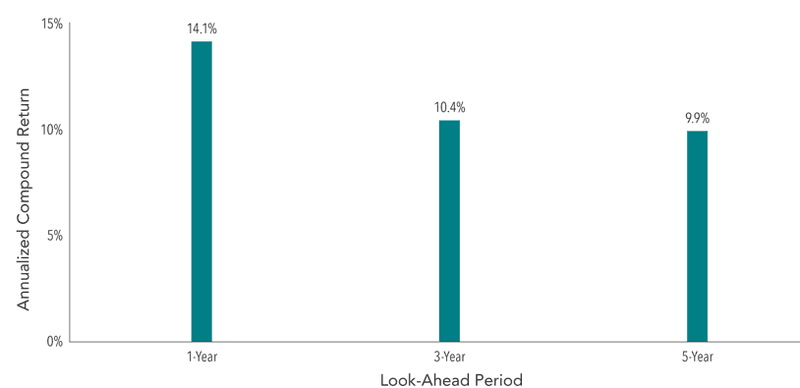
Timing Markets - Historical Perspective Graph
In US dollars. Past performance is no guarantee of future results. New market highs are defined as months ending with the market above all previous levels for the sample period. Annualized compound returns are computed for the relevant time periods subsequent to new market highs and averaged across all new market high observations. There were 1,115 observation months in the sample. January 1990–present: S&P 500 Total Returns Index. S&P data © 2019 S&P Dow Jones Indices LLC, a division of S&P Global. All rights reserved. January 1926–December 1989; S&P 500 Total Return Index, Stocks, Bonds, Bills and Inflation Yearbook™, Ibbotson Associates, Chicago. For illustrative purposes only. Index is not available for direct investment; therefore, its performance does not reflect the expenses associated with the management of an actual portfolio. There is always a risk that an investor may lose money.

The Cost of Waiting for “Perfect” Timing

So how much difference does waiting for the “perfect” moment really make? Consider this: over a 20-year period, the long-term investor who confidently puts their money to work right away could potentially end up with thousands more than someone who hesitates, holding out for a flawless entry point. That’s not just pocket change—it works out to hundreds of dollars in additional gains each year, simply by embracing a disciplined, time-in-market approach rather than striving for perfect timing.

Does Investing Right Away or Dollar-Cost Averaging Provide Guarantees?

It’s a question that often comes up: can investing all at once or spreading investments out over time—known as dollar-cost averaging—guarantee a profit or shield you from losses? Unfortunately, the answer is no.

Neither approach offers a surefire way to make money or avoid downturns, especially during volatile periods. While dollar-cost averaging does encourage discipline, helping to sidestep the urge to jump in and out of the market based on headlines or gut feelings, it doesn’t provide immunity from loss if markets decline. Similarly, investing a lump sum right away gives your money more time in the market, but it also exposes your entire investment to immediate risk.

Instead of focusing on perfect timing, investors may benefit more from setting a thoughtful strategy, maintaining diversification, and sticking with it—even when markets are unpredictable.

What If You’re Not Sure When to Invest Each Year?

It’s a common conundrum: Should you make your annual investment—say, into your IRA or a 529 plan—right away, wait for “better” timing, or spread it out over the year? While the temptation to fine-tune the moment of entry is understandable, evidence and experience suggest that decisiveness pays off.

Rather than wait on the sidelines for the “perfect” opportunity (which, spoiler alert, rarely announces itself), long-term investors are usually better served by having a plan and sticking to it. That means:

Assessing how much stock market exposure fits your goals and your stomach for risk
Acting promptly once your plan is set, without trying to outguess short-term market moves
Consistently identifying market lows is akin to finding a needle in a haystack—fun if you’re a Nobel laureate with a penchant for statistical miracles, but not a reliable strategy for most. Instead, history favors those who invest thoughtfully and don’t let indecision stall their progress. Take action with your annual contributions as soon as your plan allows, regardless of market headlines or record highs.

Lessons from Periods of Weak Equity Markets

So, what happens when markets aren’t firing on all cylinders? Even during periods characterized by subdued equity growth—think of the 1962 to 1981 stretch, which was notably challenging for investors—different investment strategies didn’t suddenly flip the script. Investing right away generally performed respectably, rarely lagging behind significantly. In fact, whether you invested immediately or tried more patient, cautious approaches, the end results often clustered closely together, with only subtle differences in long-term returns.

The takeaway is that even when equities slog through years of slower growth, no single timing strategy consistently runs away with the gold. The gap between approaches tends to narrow, and the discipline of maintaining a long-term focus still serves investors well. This consistency helps reinforce the idea that performance differences are often less dramatic than the headlines suggest—especially when time and discipline are on your side.

How Dollar-Cost Averaging Stacks Up Against Other Approaches

When it comes to investing strategies, timing the market with absolute precision is often portrayed as the gold standard. But how much does the ability to invest at just the right moments actually matter in the long run?

Consider a scenario: one investor manages to invest at the market’s lowest point every year—an exercise in perfect timing. Unsurprisingly, this approach generates the highest ending wealth over a 20-year period. However, the more remarkable insight is found when comparing this strategy to simply putting money to work right away, regardless of market fluctuations.

An investor who consistently invested as soon as funds became available—without any market timing—ended up with a final portfolio value surprisingly close to the perfectly timed strategy, despite never waiting for an ideal buying opportunity. In fact, the gap in outcomes was far smaller than most would expect, underscoring the value of getting invested and staying the course.

Dollar-cost averaging, where investments are spread out in regular intervals, also showed strong results. This method produced returns nearly on par with those who jumped in immediately each year. The explanation is straightforward: historically, markets have risen about three-quarters of the time in a typical 12-month stretch. As a result, being invested more often than not, whether all at once or by averaging in, tends to be more effective than waiting on the sidelines for that elusive “perfect” moment.

In other words, while perfect timing would be nice in theory, the reality is that consistent participation—through dollar-cost averaging or by investing promptly—delivers results that are both reliable and competitive, often without the stress or impossibility of flawless prediction.

Consistency of Investment Strategy Rankings Over the Long Haul

Are the outcomes from various investment strategies just a fluke of the particular period you pick, or do certain patterns reliably emerge across decades? To answer that, consider how different approaches have ranked over a sweeping range of long-term periods—whether we look at rolling 20-, 30-, 40-, or even 50-year timeframes, stretching all the way back to 1926.

Across most of these periods, the ranking of strategies hardly budges: the investor with perfect timing nearly always comes out on top, followed closely by those who invest right away or use a disciplined, regular investing schedule (like dollar-cost averaging). Those who wait and try to pick their spots—even with poor timing or by staying out of the market entirely—consistently lag behind.

There have been rare stretches, such as from the early 1960s to the early 1980s (a notably tough era for equities), where the gap between these strategies narrowed and immediate investing slipped a spot. However, these instances are exceptions rather than the rule.

When viewed over multiple decades, the lesson is clear: regardless of the length of the rolling period—be it 20, 30, 40, or 50 years—consistent patterns emerge. Attempting to nail perfect entry and exit points remains exceedingly difficult, and investors who either get started promptly or stick to a steady plan have historically reaped stronger and more reliable results than those waiting for the mythical “right moment” to jump in.

What If You Invest at the Worst Possible Time?

It’s natural to wonder just how much bad timing can hurt your long-term results. Imagine an investor who habitually invests at the market’s peak every year—the very worst moments, in hindsight. You might expect such poor timing to be disastrous for portfolio growth.

But here’s the surprising truth: even consistently investing at market highs has historically yielded far better results than staying out of the market altogether. A study comparing this “worst-case” scenario to simply sitting on cash found that investing—even at inopportune times—substantially outperformed keeping money on the sidelines.

While perfect timing is nearly impossible, and poor timing can leave you trailing someone who invests steadily without regard for market levels, the long-term benefits of participation remain striking. The key lesson? The discipline to remain invested tends to trump the elusive search for flawless entry points.

Considering Dollar-Cost Averaging

What if you’re hesitant to put all your money to work in the market at once? Enter dollar-cost averaging—a disciplined approach that involves investing a fixed amount at regular intervals, regardless of market conditions. This strategy can be particularly appealing if you’re wary of mistiming your entry point.

Let’s look at some potential advantages:

Encourages Ongoing Participation: Dollar-cost averaging helps bypass the inertia that keeps many investors sidelined. By automating regular contributions—much like participating in a workplace retirement plan—you get into the habit of consistent investing.
Manages Emotional Responses: Investing a lump sum right before a downturn has a way of haunting even the most stoic investor. Spreading out your investments often reduces the sting of regret if markets stumble, since no single buy makes or breaks your outcome.
Reduces Temptation to Time the Market: By committing to a schedule, you sidestep the urge to predict short-term market moves—a notoriously challenging feat, as we’ve already discussed.


However, the approach is not without tradeoffs:

Possible Missed Gains in Rising Markets: If markets trend upward during your investment period, you may end up buying shares at increasingly higher prices, potentially limiting your total return compared to investing a lump sum at the outset.
No Protection from Loss: While dollar-cost averaging can help manage volatility, it doesn’t shield your portfolio from a sustained market decline. Continuous purchases during a downtrend result in lower average costs, but there’s no assurance prices will bounce back in your timeframe.

Deciding between lump-sum investing and dollar-cost averaging depends largely on your circumstances and risk tolerance. Both require discipline—the very trait that gives investors the best odds of long-term success.

Procrastination vs. Poor Timing: Which Is Worse?

Some investors worry that investing at a market high or picking the “wrong” moment will lead to disappointing outcomes. But the numbers tell a different story. Even investors with the worst luck—those who consistently invested at market peaks—tended to fare far better than those who simply didn’t invest at all.

Consider the case of investors who delayed, waiting for the perfect time to enter the market. Over time, procrastination proved even more costly than poor market timing. The hesitant investor, sitting on the sidelines year after year, missed out on the power of compounding and long-term market growth.

The takeaway?
While trying to time the market perfectly can be challenging—and sometimes frustrating—avoiding the market altogether tends to be the most damaging decision for long-term wealth building. History shows that participating in the market, even imperfectly, typically beats sitting out and waiting for that elusive “right moment.”

The Cost of Sitting on the Sidelines

What happens if, in an effort to avoid ill-timed investments, someone simply holds onto cash and never invests in stocks at all? The data offers a clear verdict: avoiding the market altogether is often the most costly approach in the long run.

Consider the case of a hypothetical investor who kept waiting for the “perfect moment” to get in, only to remain parked in cash year after year. Rather than benefitting from the market’s long-term growth, this investor merely earns the modest returns offered by money market instruments or savings accounts—returns that often struggle to keep pace with inflation. Over time, this lack of participation results in a dramatic shortfall compared to investors who took the leap, even if their timing was far from ideal.

In fact:

An investor who “always bought at the worst possible time” but stayed the course still accumulated significantly more wealth than someone who avoided stocks altogether.
The opportunity cost of procrastination—waiting endlessly for that elusive “better entry point”—frequently surpasses the risk of experiencing short-term volatility from participating in the market.

The takeaway? Even with poor timing, persistent stock market participation has historically delivered far better outcomes than holding cash on the sidelines. Those who continually wait for the perfect scenario may find themselves left far behind as markets compound and grow.

Timing Markets – Conclusion

Outguessing markets is more difficult than many investors might think. While favorable timing is theoretically possible, there isn’t much evidence that it can be done reliably, even by professional investors.

The positive news is that investors don’t need to be able to time markets to have a good investment experience.

Over time, capital markets have rewarded investors who have taken a long-term perspective and remained disciplined in the face of short-term noise. By focusing on the things they can control (like having an appropriate asset allocation, diversification, and managing expenses, turnover, and taxes) investors can better position themselves to make the most of what capital markets have to offer.

Footnotes

[1.] In US dollars. Source: Dimensional, using data from Bloomberg LP. Includes primary and secondary exchange trading volume globally for equities. ETFs and funds are excluded. Daily averages were computed by calculating the trading volume of each stock daily as the closing price multiplied by shares traded that day. All such trading volume is summed up and divided by 252 as an approximate number of annual trading days.

[2.] Mutual Fund Landscape 2019.

Source: Dimensional Fund Advisors LP.

Indices are not available for direct investment. Their performance does not reflect the expenses associated with the management of an actual portfolio.
Past performance is not a guarantee of future results. Diversification does not eliminate the risk of market loss.
There is no guarantee investment strategies will be successful. Investing involves risks, including possible loss of principal. Investors should talk to their financial advisor prior to making any investment decision. There is always the risk that an investor may lose money. A long-term investment approach cannot guarantee a profit.
All expressions of opinion are subject to change. This article is distributed for informational purposes, and it is not to be construed as an offer, solicitation, recommendation, or endorsement of any particular security, products, or services. Robert Merton provides consulting services to Dimensional Fund Advisors LP.

About the Author Douglas Finley, MS, CPWA, CFP, AEP, CDFA

Douglas Finley, MS, CFP, AEP, CDFA founded Finley Wealth Advisors in February of 2006, as a Fiduciary Fee-Only Registered Investment Advisor, with the goal of creating a firm that eliminated the conflicts of interest inherent in the financial planner – advisor/client relationship. The firm specializes in wealth management for the middle-class millionaire.

follow me on:
>