
- You are here:
- Home »
- Blog »
- Investment Advice »
- How to React to Recent Market Volatility
How to React to Recent Market Volatility

While it may be difficult to remain calm during a substantial market decline, it is important to remember that market volatility is a normal part of the investment landscape.
In recent days the increase in volatility in the stock market has resulted in renewed anxiety for many investors. While it may be difficult to remain calm during a substantial market decline, it is important to remember that volatility is a normal part of investing. Additionally, for long-term investors, reacting emotionally to market volatility may be more detrimental to portfolio performance than the drawdown itself.
Intra-year Declines
Exhibit 1
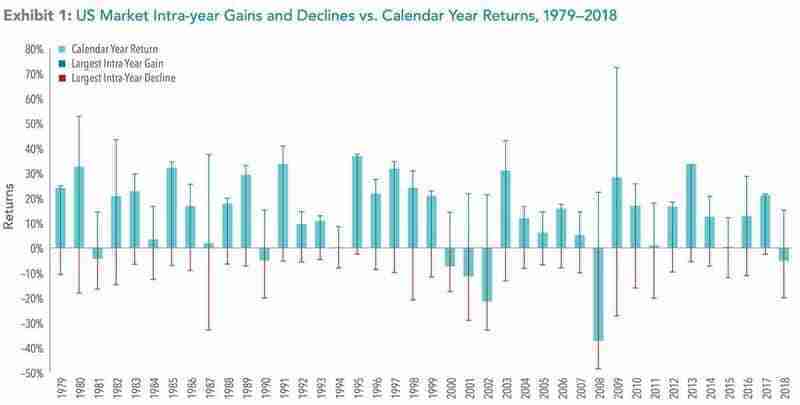
This shows calendar year returns for the US stock market since 1979, as well as the largest intra-year declines that occurred during a given year. During this period, the average intra-year decline was about 14%.
About half of the years observed had declines of more than 10%, and around a third had declines of more than 15%. Despite substantial intra-year drops, calendar year returns were positive in 33 years out of the 40 examined.
This goes to show just how common market declines are and how difficult it is to say whether a large intra-year decline will result in negative returns over the entire year.About half of the years observed had declines of more than 10%, and around a third had declines of more than 15%. Despite substantial intra-year drops, calendar year returns were positive in 33 years out of the 40 examined.
This goes to show just how common market declines are and how difficult it is to say whether a large intra-year decline will result in negative returns over the entire year.
Reacting Affects Performance
If one was to try to time the market in order to avoid the potential losses associated with periods of increased market volatility, would this help or hinder long-term performance? If current market prices aggregate the information and expectations of market participants, stock mis-pricing cannot be systematically exploited through market timing.
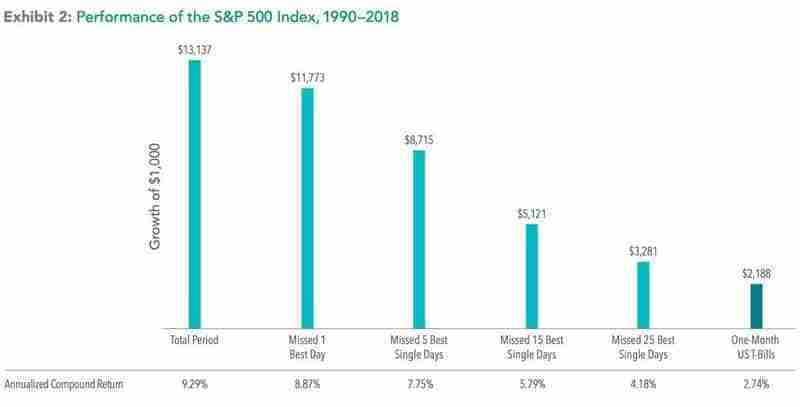
In other words, it is unlikely that investors can successfully time the market. If they do manage it, it may be a result of luck rather than skill. Further complicating the prospect of market timing being additive to portfolio performance comes from just a handful of days. A substantial proportion of the total return of stocks comes from long periods – not just a few days. Investors are unlikely to be able to identify in advance which days will have strong returns and which will not. Therefore, the prudent course is likely to remain invested during periods of volatility rather than jump into and out of stocks. Otherwise, an investor runs the risk of being on the sidelines on days when returns happen to be strongly positive.
Impact of Missing Out
Exhibit 2
Conclusion
While market volatility can be nerve-racking for investors, reacting emotionally and changing long-term investment strategies in response to short-term declines could prove more harmful than helpful. By adhering to a well-thought-out investment plan, ideally agreed upon in advance of periods of volatility, investors may be better able to remain calm during periods of short-term uncertainty.
__________________________________________________
Dimensional Fund Advisors LP is an investment advisor registered with the Securities and Exchange Commission.
- Indices are not available for direct investment. Their performance does not reflect the expenses associated with the management of an actual portfolio.
- Past performance is not a guarantee of future results. Diversification does not eliminate the risk of market loss.
- There is no guarantee investment strategies will be successful. Investing involves risks including possible loss of principal. Investors should talk to their financial advisor prior to making any investment decision. There is always the risk that an investor may lose money. A long-term investment approach cannot guarantee a profit.
- All expressions of opinion are subject to change. This article is distributed for informational purposes, and it is not to be construed as an offer, solicitation, recommendation, or endorsement of any particular security, products, or services. Investors should talk to their financial advisor prior to making any investment decision.
About the Author Doug Finley
Douglas Finley, MS, CFP, AEP, CDFA founded Finley Wealth Advisors in February of 2006, as a Fiduciary Fee-Only Registered Investment Advisor, with the goal of creating a firm that eliminated the conflicts of interest inherent in the financial planner – advisor/client relationship. The firm specializes in wealth management for the middle-class millionaire.
Related Posts
Ideal Investment Portfolio Management: Principle 10 in Evidence-Based Investing
Why Stick with a Globally Diversified Portfolio? Principle 7 in Evidence-Based Investing
Diversify Your Investment Universe: Principle 6 in Evidence-Based Investing
Understanding How Markets Work for You: Principle 4 in Evidence-Based Investing
Resist Chasing Past Performance: Principle 3 in Evidence-Based Investing
What Is Fiduciary Investment Advice, and Why Does It Matter (Now More Than Ever)?
How Has Market Behavior Evolved For Emerging Markets Investing?
When It’s Value Stocks vs. Growth Stocks, History Is on Value’s Side
Session expired
Please log in again. The login page will open in a new tab. After logging in you can close it and return to this page.